
What Makes a Good ESL Lesson?
A good lesson is more than a fun activity. It should fit the student, require meaningful work, connect to a larger curriculum, and create progress that lasts.
Introduction: A Good Lesson Is More Than a Fun Lesson
A lesson can look successful without actually accomplishing very much. A student may laugh, talk constantly, complete every activity, or tell their parents that class was fun. None of those things are bad. In fact, they can all be signs of a healthy classroom.
But they are not enough.
A good ESL lesson should have a purpose. It should fit the student’s present ability, connect to what they have learned before, require the student to think and work, and leave them more capable than they were at the beginning.
The most important question is not simply, “Did the student enjoy the lesson?”
It is:
What can the student understand, explain, say, read, or write now that they could not do—or could not do as well—before?
1. A Good Lesson Has a Clear Goal
The teacher should know what the student is supposed to understand or be able to do by the end.
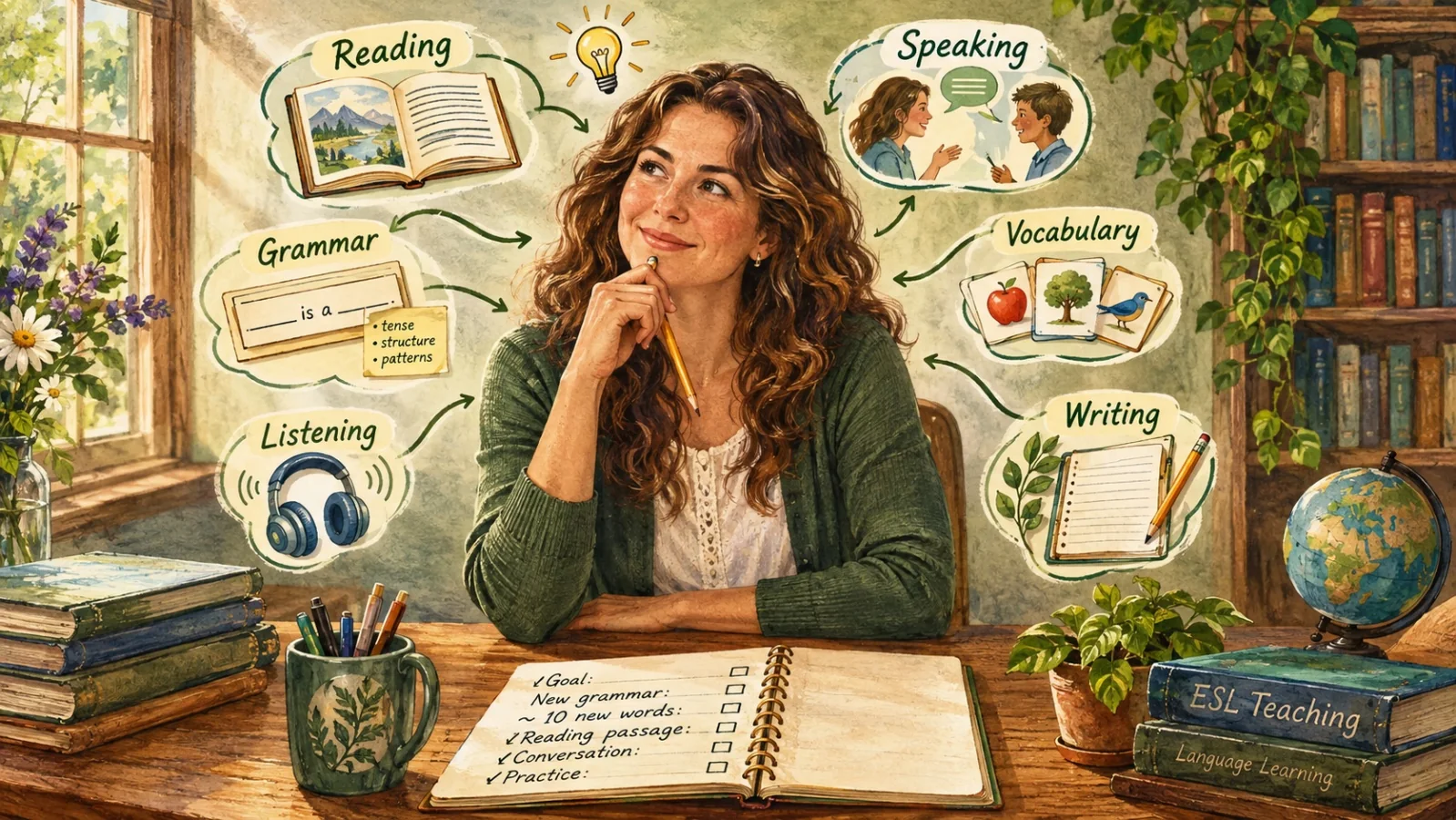
There are six major categories of language learning:
- Reading
- Writing
- Listening
- Speaking
- Grammar
- Vocabulary
A well-built lesson should develop these areas in different ways rather than treating them as six completely separate subjects.
Every lesson should have a new grammar goal to teach or a previous grammar goal to review and practice.
Every lesson should introduce approximately ten useful new words, depending on the student’s level and the difficulty of the vocabulary.
Every lesson should contain either a reading passage worth discussing or interesting conversation points capable of producing meaningful discussion.
A lesson needs both learning goals and performance goals
“Learn the past tense” is vague.
A clearer goal might be:
By the end of the lesson, the student should be able to describe what they did yesterday using regular and common irregular past-tense verbs.
The teacher can then actually test whether that happened.
The six areas should reinforce one another
Suppose the lesson is about travel.
The student might:
- learn ten travel words,
- read a short story about a trip,
- listen to someone describing a journey,
- practice past-tense grammar,
- answer comprehension questions,
- discuss their own travels,
- and finally write several sentences about a memorable trip.
Those are not seven unrelated exercises. They are seven ways of building the same network of language.
Real conversation should emerge from good lesson design
If everything is built well, then real conversation will happen between teacher and student.
The lesson itself gives the student something worth talking about.
The student can slowly use the skills they already have to learn more words, build better conversations, express increasingly complicated ideas, and remain engaged from beginning to end.
2. It Is at the Right Level
Too easy creates little growth. Too difficult creates confusion and dependence. The best lesson pushes the student just beyond what they can comfortably do alone.
All lessons should be built to follow an appropriate CEFR level.
Grammar lessons should also be strategically placed within those levels rather than introduced randomly.
The most common and useful words and sentence patterns should generally be taught first so students can use English in productive ways that they and other people value.
Productive struggle matters
A student saying, “This is hard,” does not necessarily mean the lesson is too difficult.
Some struggle is exactly what we want.
The important distinction is between productive struggle and helpless struggle.
Productive struggle means:
“I cannot do this immediately, but with some thinking, evidence, or a small hint, I can get there.”
Helpless struggle means:
“I have so little prerequisite knowledge that I cannot realistically solve this without the teacher doing most of the work.”
Difficulty can change inside the lesson
A lesson does not need to remain at one fixed difficulty.
The teacher might begin with a straightforward question to establish confidence and understanding, then move toward:
- recall,
- explanation,
- comparison,
- application,
- prediction,
- evaluation.
The same material can therefore serve different students at different depths.
3. New Skills Connect to Old Skills
Vocabulary, grammar, reading, listening, speaking, and writing should reinforce one another rather than feel like unrelated activities.
All tasks and topics of the day should relate to each other.
Each unit should contain a larger theme composed of related ideas and goals.
Everything builds upon itself.
New knowledge needs somewhere to attach
Learning becomes easier when students can connect new information to something they already understand.
If students already know:
hot, cold, rainy, sunny
then later lessons can build:
humid, freezing, scorching, forecast, climate
and eventually:
How does climate affect the way people live?
The conversation becomes increasingly sophisticated without starting from zero every time.
Grammar should appear outside the grammar section
If today’s grammar is comparative adjectives, students should not practice them for five minutes and then forget about them.
Later they might compare:
- two animals,
- two cities,
- two characters,
- two solutions,
- or two personal preferences.
The grammar becomes a tool rather than an isolated worksheet skill.
Units should build toward larger outcomes
A series of lessons about animals might begin with body parts and descriptive adjectives, move into habitats and behavior, and eventually ask students to explain adaptation, compare species, or defend which animal is best suited to a particular environment.
The difficulty grows because the knowledge grows.
4. The Student Has to Do the Work—and the Lesson Should Build Toward Independence
A teacher explaining everything perfectly is not enough.
Students need to:
- recall,
- answer,
- describe,
- predict,
- compare,
- explain,
- read,
- speak,
- solve,
- justify,
- and eventually produce language independently.
One of the biggest and most common mistakes teachers and parents can make is helping a student too much and doing too much for them.
Our job is to give them the right questions, the right tools, and the right pieces of evidence for them to build everything they need.
Support can be strong at first, but it should gradually decrease.
The student has to do the work.
“What would you do if I wasn’t here?”
That question gets directly to the goal of education.
The teacher will not always be sitting next to the student.
Neither will the parent.
Eventually the student needs strategies of their own.

Give hints in layers
Imagine a student cannot answer a reading question.
The teacher could immediately give the answer.
That is fast—but the student learns very little.
Instead:
Hint 1: “Which paragraph talks about this?”
If necessary:
Hint 2: “Look at the second half of paragraph three.”
Then:
Hint 3: underline the relevant sentence.
Then:
Hint 4: “Which word in this sentence tells you why?”
Only provide the answer when the student truly cannot reach it.
The student gets as much help as necessary, but as little help as possible.
Silence can be useful
Teachers sometimes become uncomfortable when a student does not answer immediately.
They begin talking.
Then they explain the question again.
Then they simplify it.
Then they provide half the answer.
Sometimes the student simply needed ten seconds to think.
A good teacher needs to learn when silence represents confusion and when silence represents thinking.
Students need tools, not permanent rescue
A student who forgets a word might learn to:
- look at surrounding context,
- identify the part of speech,
- use a synonym,
- describe the object another way,
- search their memory for related words,
- or ask a precise question.
Those strategies can eventually replace dependence on the teacher.
Independence eventually connects to motivation
At a certain point it must become the student’s job to know and deeply understand what their big mission and goals in life are.
If they really want to get there then they need to do the work to get there.
We cannot always be there to help them.
Another powerful question is:
If you really want this good reward, what are you willing to do to get it?
When students genuinely understand and value their goals, you may be amazed by what they are willing and able to do.
5. Good Questions Matter
“Do you understand?” is a bad question for many reasons.
A student may say yes because:
- they think they understand,
- they are embarrassed,
- they do not want another explanation,
- they want to move to the next section,
- or they simply want the entire class to end.
The word yes proves almost nothing.
Good questions reveal what students can actually do with an idea.
Ask questions that expose understanding
Instead of:
Do you understand the word generous?
Ask:
- Would a generous person share their food?
- Can someone be generous with their time?
- What is the opposite of generous?
- Tell me about something generous someone could do.
- Can someone give you something expensive but still not be generous? Why?
Now we are testing the concept.
Build questions upward
Good questions can progress from simple to difficult.
Identify:
What does it mean?
Classify:
Is it a noun, verb, or adjective?
Connect:
What nouns, verbs, and adjectives are related to it?
Compare:
How is X different from Y?
Apply:
When might you use it?
Change the situation:
What if X happened instead of Y?
Evaluate:
Would that be a good idea? Why?
“Why?” is often the real question
“Would you want it?” is not especially difficult.
A student can say yes or no.
“Why?” forces language.
Now the student needs evidence, reasoning, vocabulary, grammar, and organization.
Good questions teach thinking as well as English
Eventually questions can move beyond language practice:
- What is the character’s biggest mistake?
- Which solution is fairer?
- What evidence supports your opinion?
- What would happen if everyone behaved this way?
- Can two people disagree and both have reasonable arguments?
At that point, English becomes the medium through which the student learns to think more carefully.
6. Mistakes Are Useful Information
Errors tell the teacher what the student understands, where the gap is, and what should happen next.
F is for feedback, not failure.
Mistakes are some of the best evidence a teacher can receive.
Different mistakes mean different things
If a student says:
“Yesterday I go swimming.”
they may clearly understand past time but not yet automatically produce the correct past-tense verb.
That is a very different problem from a student who does not understand when the event happened at all.
The mistake helps diagnose the missing piece.
Look for patterns, not isolated imperfections
One mistake may mean almost nothing.
Five similar mistakes mean something.
If a student repeatedly:
- forgets articles,
- confuses past and present,
- avoids longer sentences,
- or misuses prepositions,
that pattern can become tomorrow’s lesson.
Listening is part of teaching
When you learn how to listen well, you learn how to teach well.
A teacher who is constantly thinking about what to say next can miss the most valuable information in the classroom: what the student is actually saying.
7. Review Should Be Built Into the Lesson
A good lesson does not introduce something once and assume it is learned.
Important language should return repeatedly in different contexts.
You can never fully “know” how much a student has learned at any one moment.
The best you can do is test them on this particular day and develop a good estimate of what they can currently do.
Tomorrow they may forget something they knew today.
Or they may make a mistake today and suddenly remember the correct answer tomorrow.
Learning moves.
Review should be distributed
Suppose the student learns the word enormous.
Do not merely ask for the definition five times in five minutes.
Instead:
Beginning:
Teach enormous.
Middle:
Ask which animal in the story is enormous.
Later:
Compare large, huge, and enormous.
End:
Ask the student to describe something enormous without using the word itself.
Next lesson:
Bring it back unexpectedly.
That is much stronger review.
Retrieval matters
Seeing the answer again is not the same as remembering it.
Students should sometimes have to retrieve information without being shown it first.
“What were three of yesterday’s vocabulary words?”
is more revealing than:
“Here are yesterday’s vocabulary words. Do you remember them?”
Difficult material should return more often
Grammar and vocabulary should normally be reviewed at least two or three times.
The harder something is, the more likely it should return.
Easy knowledge does not need the same amount of repetition as fragile knowledge.
Growth never really ends
Practice makes better and we can always do better.
That is one of the cornerstones of a growth mindset.
We do not need to tell ourselves:
“I am bad at this.”
or even:
“I have mastered this forever.”
Instead:
“This is what I can do today. What is the next thing I can improve?”
8. A Good Lesson Fits Into a Larger Curriculum
Even an excellent standalone lesson loses value when tomorrow’s lesson has no relationship to it.
Individual lessons should be part of a larger progression.
Curriculum prevents accidental gaps
Without a structured progression, teachers may repeatedly teach their favorite topics while accidentally ignoring important skills.
A curriculum helps answer:
- What has this student already learned?
- What should they learn next?
- What prerequisite skills are missing?
Sequence matters
A student should not be asked to build complicated structures before mastering the pieces inside them.
Simple sentences can lead to compound sentences.
Compound sentences can lead to complex sentences.
Paragraphs can lead to essays.
Simple tense control can lead toward more sophisticated tense relationships.
The order matters.
A curriculum creates cumulative power
One lesson should make the next lesson easier.
Ten lessons should make the eleventh lesson substantially richer.
One hundred lessons should produce abilities that could never have emerged from one hundred disconnected worksheets.
That is the difference between having lessons and having a curriculum.
9. Engagement Matters—but Engagement Is Not the Goal
Students should be interested and mentally involved, but entertainment should serve learning rather than replace it.
This becomes especially tricky with advanced students.
Sometimes intelligence can be a curse.
Some students are cool, clever, funny, charismatic, and genuinely enjoyable to talk with.
They may also believe they already know enough.
Some might even be bold enough to tell the teacher that they are smarter than the teacher.
And sometimes they may be right about particular things.
They can talk forever about random subjects.
From outside the room, this can look extremely impressive.
A parent may walk by and think:
“Wow. My child can talk with this really smart teacher forever. I’m so proud!”
But enjoyable conversation alone is not necessarily progress.
Fluency can hide stagnation
A strong student may repeatedly use:
- the same vocabulary,
- the same sentence structures,
- the same favorite topics,
- the same jokes,
- and the same arguments.
They may sound fluent because they have become extremely comfortable operating inside territory they already know.
The teacher’s job is to keep expanding that territory.
Parents should ask evidence-based questions
After class, instead of asking only:
“Did you have fun?”
parents can ask:
- “What are three or five new words that you learned today?”
- “What is one new big idea or skill that you didn’t know before today?”
- “What did you talk about?”
- “What did the teacher tell you today?”
Then listen carefully.
Follow-up questions matter
If the student says:
“We talked about climate change.”
the parent might ask:
- “What did you learn about it?”
- “What new vocabulary did you use?”
- “Did you and the teacher disagree about anything?”
- “What was the hardest question?”
Now the parent is looking for evidence of intellectual growth rather than evidence that conversation occurred.
Engagement is the vehicle
A boring lesson can certainly be improved.
Curiosity matters.
Humor matters.
Stories matter.
Interesting disagreements matter.
But the purpose of those tools is to draw the student deeper into learning.
Entertainment should serve learning rather than replace it.
10. The Teacher Should Adapt Without Losing the Objective
If something is too hard, too easy, or unexpectedly interesting, a good teacher adjusts while still protecting the lesson’s larger purpose.
When reading becomes too difficult
Suppose a student is reading a paragraph and struggling with many words.
I might underline several difficult words and ask the student to read the entire paragraph or page before stopping.
This can make the activity much faster.
If we stop after every difficult word, a five-minute reading task can easily become ten or fifteen minutes.
And we do not always need to teach every unfamiliar word.
Vocabulary should be prioritized
The most important words are usually:
- First: common words the student is likely to encounter repeatedly.
- Second: words that are necessary for understanding the passage.
- Third: useful topic-specific vocabulary.
- At the bottom are rare or obscure words that may contribute very little to the student’s broader English ability.
Sometimes I may simply substitute an obscure word with a more common synonym and keep moving.
Sometimes simplification is necessary
If a paragraph is extremely difficult, I may occasionally allow the student to finish reading it and then essentially say:
“All right. Forget that version. Here is what this paragraph is really saying.”
Then I explain the central idea in simpler English.
That is something I keep in my pocket rather than something I want to use constantly.
If it happens repeatedly, it is valuable evidence that the lesson may simply be too difficult for the student.
Perhaps the correct adaptation is not another hint.
Perhaps the correct adaptation is moving down a level.
Adaptation also means making easy lessons harder
Some students deliberately prefer easier material.
That is not always bad.
Easy material can create fluency, confidence, and room for deeper conversation.
But occasionally the teacher should push beyond the page.
Ask:
- What are the bigger ideas or themes within this lesson?
- How can I connect this story to the student’s life?
- How can I use the ideas in this lesson to help them reach their bigger life goals?
- How can I get this student to think of something that they never thought of before?
Those questions often guide me when I want to make an apparently easy lesson intellectually harder.
Preserve the destination even when changing the road
Good teaching is not blindly following a lesson plan.
But neither is it abandoning the plan every time the conversation becomes interesting.
A teacher can change:
- the question,
- the example,
- the reading difficulty,
- the amount of support,
- the pace,
- or the route.
But the teacher should still know what destination they are trying to reach.
11. How Do We Know the Lesson Worked?
The most important question: can the student do something afterward that they could not do—or could not do as well—before?
Improvement can be small
Success does not require a dramatic transformation every lesson.
Perhaps today the student:
- remembered five new words,
- corrected a tense mistake,
- read a difficult paragraph more smoothly,
- gave a longer answer,
- asked a better question,
- or explained an opinion with evidence.
Those are real gains.
Look for transfer
The strongest sign of learning is when the student uses something without being told to use it.
A student learns a new transition word on Monday.
On Friday they naturally use it while explaining an unrelated story.
That is powerful evidence.
The skill has begun moving from lesson content into usable language.
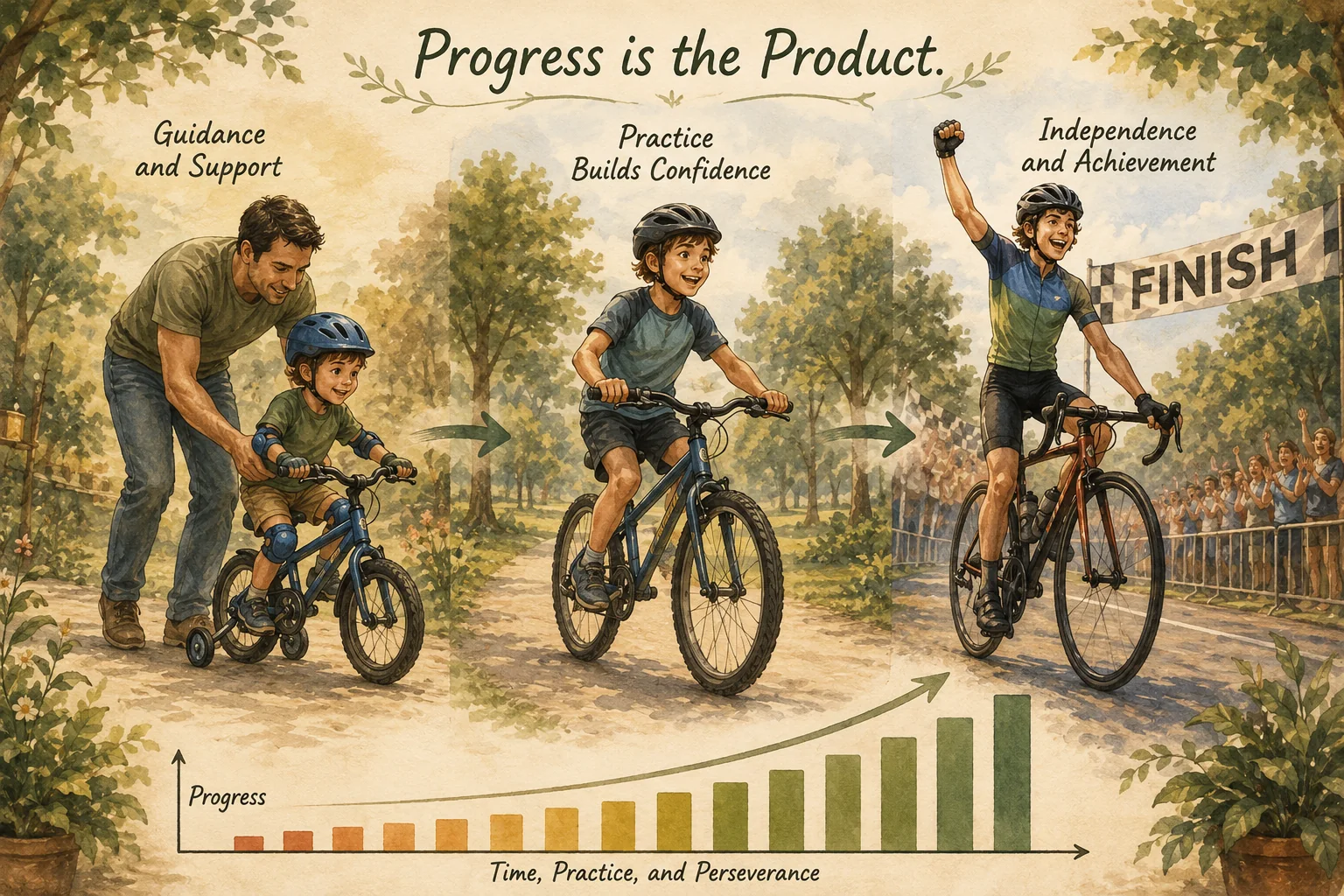
Progress should accumulate
One lesson may create only a small change.
But small changes compound.
If lessons repeatedly produce useful gains, months later the student should be able to look backward and see a very different version of themselves.
Conclusion: Progress Is the Product
A good lesson should ultimately create measurable, cumulative growth and make the student increasingly capable and independent.
A lesson can be funny.
It can be exciting.
It can contain beautiful materials, interesting stories, difficult questions, and wonderful conversations.
Those things are valuable.
But the lesson exists for something larger.
Teachers should gradually make themselves less necessary
One strange measure of excellent teaching is that, over time, the student should need the teacher less.
The student learns how to:
- understand,
- investigate,
- practice,
- correct,
- question,
- communicate,
- and continue learning independently.
The activity is not the product.
The worksheet is not the product.
The textbook page is not the product.
Even the lesson itself is not really the product.
Progress is the product.